

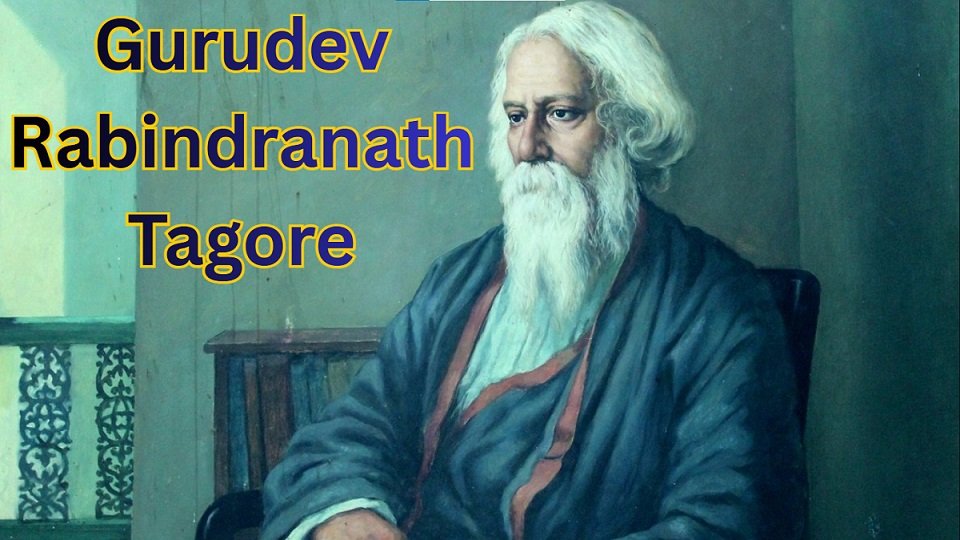

Gurudev Rabindranath Tagore – The Poet Who Defined Indian Literature
Gurudev Rabindranath Tagore, one of the greatest luminaries inside the world of paintings and literature, is often seemed because the “Bard of Bengal”. He became a poet, logician, novelist, painter, playwright, composer, and educationist whose mind transcended borders and cultures. Tagore’s works, written specifically in Bengali, were later translated into many languages, earning him recognition on the global stage.
Born in an generation while India emerge as beneath British colonial rule, Tagore’s literary and musical contributions helped ignite the spirit of nationalism, spiritualism, and cultural pride among Indians. He remains the first non-European Nobel Laureate in Literature, receiving the respect in 1913 for his English translation of Gitanjali (Song Offerings).
Early Life and Family Background
Gurudev Rabindranath Tagore became born on May 7, 1861, within the Jorasanko Thakur Bari, Kolkata (then Calcutta), India. He grow to be the youngest of thirteen youngsters born into the outstanding Tagore circle of relatives, which became deeply concerned in social reforms, arts, and literature.
His father, Debendranath Tagore, have become a respected reality seeker and chief of the Brahmo Samaj, a spiritual reform movement. His mother, Sarada Devi, became a pious and type-hearted lady who deeply inspired Tagore’s early ethical values.
Growing up in a family full of tune, poetry, and art, more youthful Rabindranath advanced a natural inclination in the direction of creativity. His brothers and sisters had been additionally artists, musicians, and writers, which created a vibrant environment for intellectual and cultural increase.
Education and Early Influences
Rabindranath Tagore’s formal schooling modified into unconventional. He attended various faculties, which includes Oriental Seminary and St. Xavier’s School, however he regularly discovered the rigid faculty gadget uninspiring. Instead, he desired self-learning via declaration and nature.
In 1878, Tagore went to England to take a look at law at University College London, however he soon left without completing his diploma. However, his time in England introduced him to Western literature, song, and tradition, which deeply prompted his writing style and philosophy.
Tagore’s educational philosophy later inspired him to set up Visva-Bharati University at Santiniketan in 1921 — an group that aimed to mixture the excellent of Eastern and Western training.
Literary Career: The Making of a Literary Legend
Rabindranath Tagore’s literary journey started at a younger age. He began writing poems at just eight and published his first essential collection of poems, “Kabi Kahini”, at the age of sixteen beneath the pseudonym Bhanusimha.
🖋️ His Major Literary Works Include:
1. Poetry
- Gitanjali (Song Offerings) – His most famous paintings, a set of devotional poems for which he obtained the Nobel Prize in 1913.
- Sonar Tori (The Golden Boat)
- Manasi (The Ideal One)
- Balaka (The Flight of Cranes)
- Purabi and Kheya (The Ferry Boat)
2. Novels
Tagore’s novels regularly explored the human situation, societal norms, and the conflicts amongst manner of existence and modernity.
- Gora
- Ghare-Baire (The Home and the World)
- Chokher Bali (A Grain of Sand)
- Shesher Kobita (The Last Poem)
3. Short Stories
Tagore is regarded as the father of the Indian quick tale. His storytelling combined realism with compassion.
- Kabuliwala
- Postmaster
- The Hungry Stones
- Subha
4. Plays
His performs like Dak Ghar (The Post Office), Raktakarabi (Red Oleanders), and Achalayatan replicate his problem for human freedom, social justice, and the non secular awakening of mankind.
Contribution to Music: The Birth of Rabindra Sangeet
One of the most high-quality elements of Tagore’s genius modified into his contribution to tune. He composed over 2,000 songs, collectively known as Rabindra Sangeet, which form a completely precise musical lifestyle in Bengal.
His compositions combine Indian classical track with Western melodies and often convey deep emotions of affection, devotion, and patriotism.
Interestingly, two of his compositions later have become country wide anthems:
- “Jana Gana Mana” – National Anthem of India
- “Amar Sonar Bangla” – National Anthem of Bangladesh
This high-quality achievement makes Tagore the most effective character in information to have written the countrywide anthems of two international locations.
Tagore’s Philosophy and Spirituality
Tagore’s philosophy changed into rooted in humanism, universalism, and religious freedom. He believed that humanity transcended all country wide, racial, and non secular boundaries.
His thoughts were deeply inspired by Upanishadic teachings, emphasizing cohesion with the divine and the significance of love and truth in human lifestyles. He predicted a worldwide where man and nature coexist harmoniously — a topic glaring in tons of his poetry.
He often said,
“The highest education is that which does now not merely supply us information however makes our existence in harmony with all existence.”
Tagore as a Painter and Artist
Surprisingly, Rabindranath Tagore started painting overdue in lifestyles, across the age of 60. Yet, he went immediately to create over 2,300 art work and drawings, showcasing his creativity and originality. His creative endeavors, characterized through precis bureaucracy and colourful colorations, were displayed in exhibitions international, together with in Paris, London, and Tokyo.
His artwork reflected his inner worldwide — filled with goals, emotions, and spiritual depth.
Role in Indian Freedom Movement
Although Tagore became no longer straight away involved in lively politics, his writings inspired a sense of nationalism among Indians. His tune “Jana Gana Mana” modified into first sung in 1911 on the Indian National Congress session.
He become deeply moved via the Jallianwala Bagh bloodbath (1919) and as a mark of protest, he renounced his knighthood offered via the British government. In his letter to Lord Chelmsford, Tagore wrote approximately his sorrow and ethical outrage, turning into one of the first cultural leaders to take a stand in opposition to colonial injustice.
Establishment of Visva-Bharati University
In 1921, Tagore based totally Visva-Bharati University at Santiniketan, West Bengal. His purpose have become to create a place of studying that combined Indian and Western traditions — where college students ought to research via nature, art, and speak.
The college have become a center for cultural alternate and highbrow growth. Eminent personalities like Mahatma Gandhi, C.F. Andrews, and Leonard Elmhirst had been related to it. Today, Visva-Bharati remains surely one in every of India’s most reputable academic establishments.
International Recognition and Nobel Prize
Rabindranath Tagore have turn out to be an worldwide figure whilst he posted the English translation of his poems in Gitanjali (Song Offerings). His religious and lyrical expressions of human emotions captivated the Western international.
In 1913, he received the Nobel Prize in Literature, becoming the first Asian to achieve this honor. The Swedish Academy praised his work for its “profoundly sensitive, glowing and exquisite verse.”
Tagore’s have an impact on spread throughout the globe — he met personalities like Albert Einstein, Romain Rolland, and W.B. Yeats, who well-known his highbrow intensity and creativity.
Death and Legacy
Rabindranath Tagore exceeded away on August 7, 1941, at his ancestral domestic in Kolkata. His dying marked the quit of an technology, but his legacy keeps to light up the world.
Even these days, his works are celebrated at some point of literature, tune, and artwork. His poems are taught in schools, his songs are sung at cultural gatherings, and his mind keep to inspire modern training and social reform.
Important Information About Gurudev Rabindranath Tagore
| Field | Details |
|---|---|
| Full Name | Rabindranath Tagore |
| Popular Name | Gurudev |
| Date of Birth | May 7, 1861 |
| Place of Birth | Kolkata (Calcutta), India |
| Father’s Name | Debendranath Tagore |
| Mother’s Name | Sarada Devi |
| Spouse | Mrinalini Devi |
| Children | Five (Two sons, three daughters) |
| Profession | Poet, Writer, Composer, Painter, Philosopher |
| Major Works | Gitanjali, Gora, Ghare-Baire, Kabuliwala |
| Award | Nobel Prize in Literature (1913) |
| Educational Institution Founded | Visva-Bharati University, Santiniketan |
| National Anthems Written | India (Jana Gana Mana), Bangladesh (Amar Sonar Bangla) |
| Date of Death | August 7, 1941 |
| Legacy | Global literary icon, philosopher, and symbol of Indian cultural renaissance |
Rabindranath Tagore’s Quotes That Inspire Generations
“You can’t pass the sea merely through status and gazing the water.”
“Faith is the chicken that feels the mild and sings while the sunrise is still darkish.”
“Let your lifestyles gently dance on the edges of Time like dew on the tip of a leaf.”
“The butterfly counts no longer months however moments, and has time sufficient.”
These undying fees mirror his understanding, simplicity, and spiritual expertise of lifestyles.
Influence on Modern India
Rabindranath Tagore’s ideas on education, art, and freedom retain to shape cutting-edge India. His advocacy for creativity over rote analyzing has stimulated new educational reforms. His mind on rural improvement and global peace stay relevant nowadays.
Many Indian artists, musicians, and thinkers — which consist of Satyajit Ray, Amartya Sen, and Indira Gandhi — have credited Tagore’s philosophy as a supply of suggestion in their artwork.
Global Impact
Tagore’s legacy extends past India. His visits to countries like Japan, China, and the USA promoted intercultural communicate. He believed within the idea of “Vasudhaiva Kutumbakam” — the arena as one family — which resonates strongly in today’s globalized global.
UNESCO identified Tagore’s 150th transport anniversary in 2011 as a global occasion, reaffirming his region as considered one of humanity’s best innovative minds.
Conclusion
Gurudev Rabindranath Tagore have become no longer simplest a poet but a visionary truth seeker who shaped India’s cultural and highbrow identity. His phrases carried a ordinary message of affection, peace, and spiritual freedom. Whether thru Gitanjali’s soulful verses, Ghare-Baire’s deep social statement, or Rabindra Sangeet’s everlasting melodies, Tagore keeps to guide generations in the direction of harmony and truth.
His existence reminds us that actual schooling lies no longer in the books we study, but inside the values we stay — a lesson as relevant today because it changed into a century in the past.