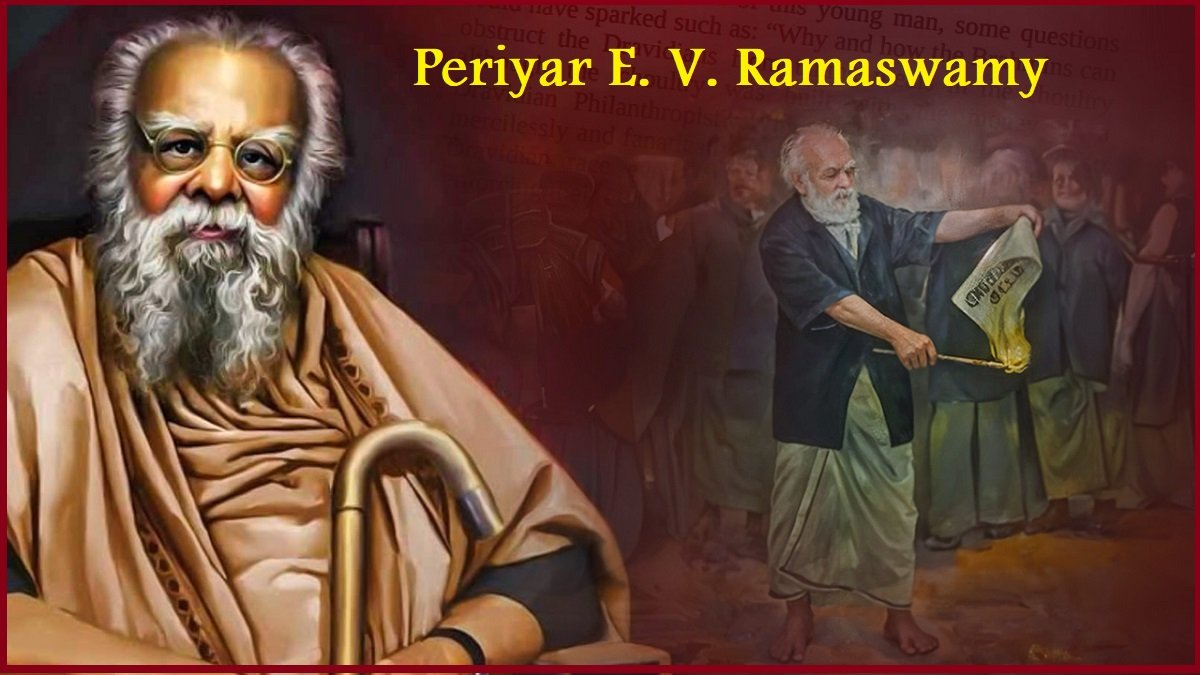
Periyar Ramaswamy – The Father of the Dravidian Movement
Periyar Erode Venkatappa Ramaswamy (generally called Periyar) changed into one in all India’s most fearless and revolutionary social reformers. His thoughts shook the principles of caste discrimination, spiritual orthodoxy, and gender inequality in South India. Known for his rationalist, reformist, and humanist outlook, Periyar’s name remains deeply engraved in Tamil Nadu’s social and political identification.
Born in 1879 and passing away in 1973, Periyar’s existence covered an technology of enormous alternate — from British colonialism to Indian independence and the upward thrust of Dravidian politics. He become extra than a flesh presser or reformer; he became a logician of equality who inspired generations to question social injustice and call for human dignity.
Table of Key Information about Periyar Ramaswamy
| Information | Details |
|---|---|
| Full Name | Erode Venkatappa Ramaswamy Naicker |
| Popularly Known As | Periyar (“The Great One”) |
| Date of Birth | September 17, 1879 |
| Place of Birth | Erode, Tamil Nadu (then Madras Presidency) |
| Parents | Venkata Naicker and Chinnathayammal |
| Wife | Nagammai (First), later Maniammai |
| Death | December 24, 1973 |
| Profession | Social Reformer, Politician, Activist, Writer |
| Movement Founded | Self-Respect Movement (1925) |
| Political Party | Justice Party (Later Dravidar Kazhagam) |
| Ideologies | Rationalism, Atheism, Anti-Caste, Women’s Rights |
| Famous Journal | Kudi Arasu (People’s Rule) |
| Legacy | Foundation of Dravidian Movement and Social Justice Policies |
Early Life and Childhood
Periyar Ramaswamy changed into born into a wealthy Balija Naicker own family in Erode. His father, a rich merchant, furnished a snug lifestyle, however the younger Ramaswamy turned into disturbed by using the deep-rooted inequalities around him. Though he received limited formal schooling, his sharp mind and experience of justice developed early via revel in instead of books.
As a young guy, he become deeply spiritual. However, his pilgrimage to Kashi (Varanasi) became a turning factor. There, he confronted discrimination because of caste when he turned into denied access into a Brahmin-run eatery. This humiliating revel in changed his life all the time — convincing him that faith and caste had been gear of oppression. From that day, he dedicated his lifestyles to fighting superstition and inequality.
Journey into Public Life
Periyar’s first step into politics got here whilst he joined the Indian National Congress in 1919. He favourite its anti-British warfare and was hoping it’d also fight social discrimination. However, he soon realized that top-caste dominance turned into similarly robust in the Congress. Despite his honest efforts, he found that the Congress did no longer deal with caste inequality significantly.
In 1925, after years of battle and disappointment, Periyar resigned from the Congress and determined to build an unbiased movement committed absolutely to social reform and self-appreciate.
Read More: Gurudev Rabindranath Tagore – Biography, Works, Poems, Books, Education & Legacy
The Birth of the Self-Respect Movement
In 1925, Periyar founded the Self-Respect Movement (Suya Mariyathai Iyakkam) in Tamil Nadu. The center philosophy was simple but revolutionary:
“No guy is superior with the aid of beginning; all humans deserve same dignity.”
This motion aimed to:
- Eradicate the caste system
- Promote equality between women and men
- Encourage rational thinking over blind religion
- Oppose the domination of Brahmins in administration and education
- Advocate inter-caste and inter-non secular marriages with out clergymen
Through fiery speeches and writings, Periyar attacked rituals, idol worship, and gender-based restrictions. His newspaper Kudi Arasu have become the voice of the oppressed.
Political Career – Justice Party and Dravidar Kazhagam
After leaving the Congress, Periyar joined the Justice Party, which represented non-Brahmin groups. In 1939, he have become its president. Under his management, the party converted from a political platform to a social revolution.
In 1944, he renamed it the Dravidar Kazhagam (DK) — the “Party of Dravidians.” The DK stood towards casteism, linguistic imperialism, and North Indian dominance. Periyar even expected a separate u . S . Called “Dravida Nadu”, where equality and rationalism could reign supreme.
Though DK later split (leading to the formation of the DMK underneath C.N. Annadurai), each events persisted to uphold Periyar’s social beliefs.
Periyar’s Philosophy and Ideology
Periyar’s philosophy was grounded in rationalism, self-appreciate, and social equality. He asked people to question the entirety — from scriptures to social customs.
Key Pillars of Periyar’s Ideology:
- Rationalism – Believe only in what may be proved by way of reason.
- Equality – No human need to be discriminated towards because of beginning, gender, or religion.
- Atheism – Religion should now not dictate morality; humanism ought to.
- Self-Respect – Every man or woman have to take pleasure in their identity without bowing to oppressive traditions.
- Women’s Liberation – He fought for women’s schooling, belongings rights, and equality in marriage.
- Language & Culture – He defended the Tamil language against the compelled imposition of Hindi.
Role in Social Reforms
Periyar changed into no longer only a philosopher; he turned into a doer. His Self-Respect Movement modified Tamil society via realistic reforms.
Major Social Reforms Led by means of Periyar:
- Abolition of Caste Titles: Encouraged humans to drop caste surnames.
- Temple Entry Movement: Supported lower castes coming into temples.
- Inter-Caste Marriages: Promoted marriages with out spiritual rituals.
- Women’s Empowerment: Advocated widow remarriage and opposed dowry.
- Education for All: Believed schooling turned into the weapon to ruin inequality.
- Anti-Hindi Agitations: Protested against Hindi imposition in Tamil Nadu (1938).
Through relentless activism, Periyar gave Tamil Nadu a new social sense of right and wrong.
Relationship with Religion
Periyar become regularly categorized as an atheist, but in reality, he turned into a humanist. He didn’t oppose spirituality itself but antagonistic the use of religion to justify injustice. He argued that blind religion and priestly power kept the hundreds submissive.
He regularly said:
“He who created God is foolish, and he who propagates God is a scoundrel.”
His views were controversial, yet they advocated hundreds of thousands to think independently.
Women’s Rights and Feminism
Periyar turned into one of the earliest Indian men to openly aid feminism. He believed ladies should have manage over their lives, education, and marriage alternatives. He criticized patriarchal customs that confined ladies’s freedom.
His contributions to ladies’s rights covered:
- Campaigning against child marriage
- Supporting widow remarriage
- Advocating identical belongings rights for ladies
- Encouraging beginning control and training
- Opposing devadasi machine and other oppressive rituals
In many ways, Periyar changed into a century in advance of his time.
Anti-Hindi and Language Policy
In 1937, when the authorities made Hindi compulsory in Tamil Nadu colleges, Periyar launched a huge Anti-Hindi agitation. He viewed language imposition as a shape of cultural dominance.
This struggle become no longer towards any language but against the lack of Tamil identity. His protests succeeded, and the coverage turned into withdrawn. This victory strengthened Dravidian delight and laid the muse for Tamil Nadu’s linguistic autonomy.
Timeline of Major Events
| Year | Event |
|---|---|
| 1879 | Born in Erode, Tamil Nadu |
| 1904 | Pilgrimage to Kashi – witnessed caste discrimination |
| 1919 | Joined Indian National Congress |
| 1925 | Founded the Self-Respect Movement |
| 1937 | Led Anti-Hindi Agitation |
| 1939 | Became President of Justice Party |
| 1944 | Formed Dravidar Kazhagam |
| 1949 | DMK split from DK under C.N. Annadurai |
| 1970 | Recognized as the “Father of the Dravidian Movement” |
| 1973 | Passed away in Vellore, Tamil Nadu |
Periyar’s Influence on Tamil Nadu and Beyond
Periyar’s ideas absolutely reshaped Tamil society. The Dravidian political events (DMK and AIADMK) that later dominated Tamil Nadu drew their thought from his principles.
His legacy is visible in:
- Reservation rules for social justice
- Women’s schooling programs
- Tamil linguistic satisfaction
- Abolition of caste symbols and honorifics
Even a long time after his demise, Tamil Nadu celebrates September 17 as Social Justice Day in his memory.
Criticism and Controversies
Like every high-quality reformer, Periyar faced grievance. His atheistic statements angered non secular organizations. His harsh tone in opposition to Brahminism become frequently misunderstood as hatred closer to Brahmins, even though he focused the system, not people.
Some critics accused him of being too radical, even as others argued that his separatist ideas (like “Dravida Nadu”) were divisive. However, even his most harsh critics admit that he changed India’s social discourse for all time.
Death and Legacy
Periyar surpassed away on December 24, 1973, at the age of 94. His funeral become attended by way of thousands of followers who taken into consideration him now not only a leader however a social prophet.
Today, his thoughts maintain to inspire moves for equality, rationalism, and gender justice. His memorials in Tamil Nadu stand as symbols of courage and social awakening.
Lessons from Periyar’s Life
- Question the entirety — in particular subculture and authority.
- Fight inequality — no matter how deep-rooted.
- Respect women — equality starts at domestic.
- Value education — it’s the real liberator.
- Be rational — assume, motive, and reform.
Periyar’s Enduring Relevance
Even within the 21st century, Periyar’s message stays effective. In a international divided by means of religion, caste, and gender bias, his voice nonetheless echoes:
“Wisdom lies in questioning. The spearhead of questioning is rationalism.”
Social reformers, pupils, and politicians throughout India apprehend that Periyar’s movement was the muse of contemporary Tamil Nadu’s social justice machine.
Conclusion
Periyar Ramaswamy become no longer just a guy — he became a movement. His fight for equality, rational idea, and self-respect maintains to guide millions. Though he lived a century in the past, his thoughts remain strikingly modern.
He taught society that real freedom comes now not just from independence from rulers however from freedom from lack of know-how, caste, and blind religion. His fearless voice in opposition to inequality earned him the identify of Periyar — “The Great One.”